CGSC Crest
Redirecting...

DDE Advanced Operations Course (AOC)

U.S. Army Command and General Staff Officer Course


AOC Purpose
The Advanced Operations Course prepares field grade officers to serve effectively on division and corps staffs during Large-Scale Combat Operations (LSCO) and Multi-Domain Operations (MDO). The course develops advanced planning and integration skills essential for operational-level staff work.

AOC Structure
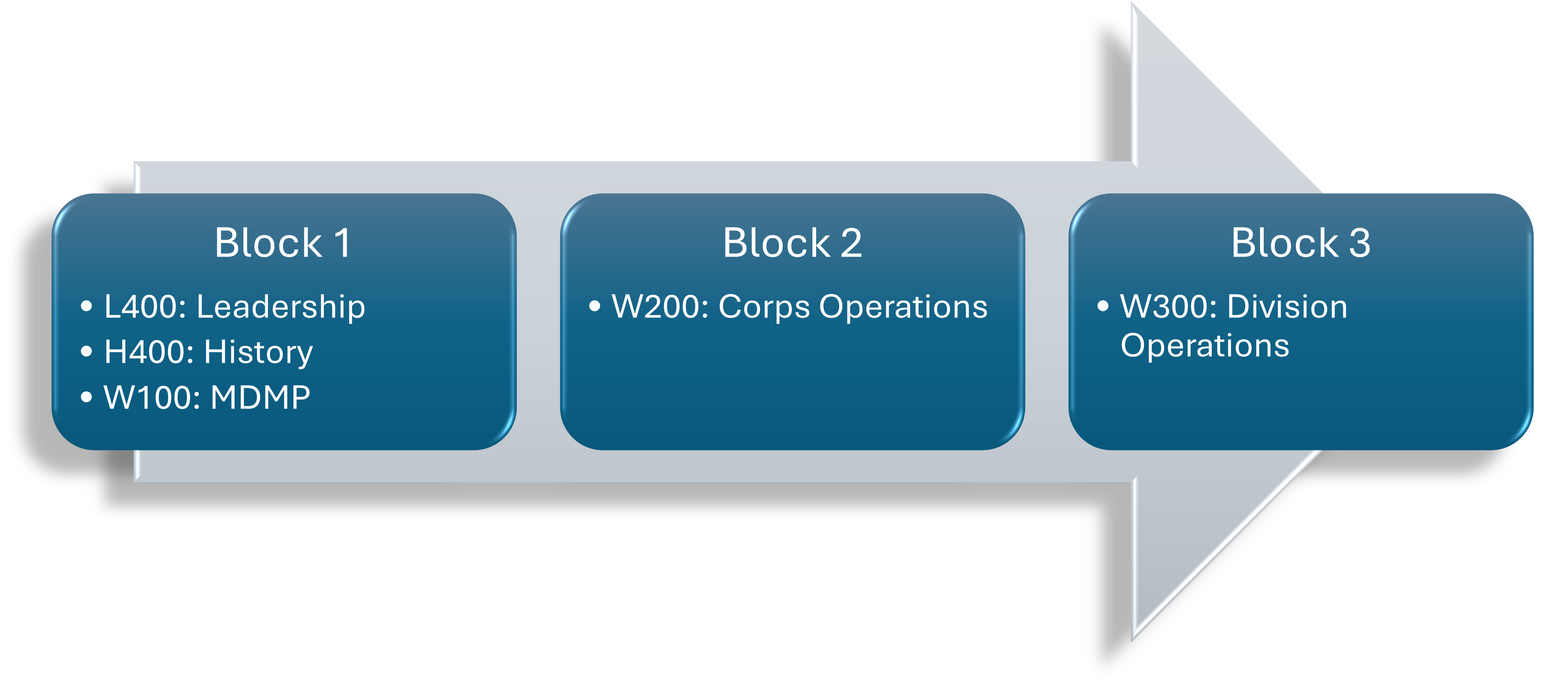
The AOC program consists of three specialized blocks focused on leadership and planning foundations, corps operations, and division operations. Each block builds progressively, developing your ability to plan, coordinate, and execute complex operational-level tasks.
Key Features

Applied Learning - Extensive practicum exercises place you in realistic division and corps staff scenarios
Cross-Functional Integration - Learn how staff sections and warfighting functions integrate for operational success
Operational-Level Focus - Develop skills specifically relevant to division and corps headquarters operations
This advanced program builds on your CGSOC Common Core foundation, developing specialized knowledge and skills for operational-level staff positions.
Advanced Operations Course: Developing operational-level staff expertise at corps and division levels.

Course Laydown

Block 1: Leadership, History & Planning Foundations

Block 1 establishes leadership, historical context, and planning fundamentals essential for operational-level staff work.

L400: Leadership
Purpose: Examine the art of command and develop adaptive leadership skills essential for operational-level success in complex, uncertain environments.

What You'll Study:

  • Command philosophy, responsibilities, and the art versus science of command at division and corps levels

  • Complexity in military operations and frameworks for managing uncertainty in LSCO and MDO

  • Adaptive leadership principles for leading through change and organizational transformation

  • Commander's visualization process and staff support to translating vision into executable plans

  • Cognitive biases, organizational impediments, and strategies to overcome decision-making obstacles

  • Building and maintaining ethically aligned organizations under operational pressures

Outcome: You will understand how to lead effectively at the operational level, support commander's decision-making, and build resilient organizations capable of adapting to complex operational environments.
Learn more on the Department of Command and Leadership page

H400: Military History

Purpose: Gain a comprehensive understanding of American military operations from World War II through recent conflicts, analyzing how historical lessons inform contemporary operational art and strategic decision-making.

What You'll Study:

  • Evolution of American strategic thinking, global strategy, and industrial mobilization during World War II

  • Large-scale combat operations in Europe and enduring lessons for contemporary LSCO and MDO

  • Deterrence theory, limited warfare concepts, and expeditionary operations in the nuclear age

  • Korean War as both limited war and large-scale combat operation, including coalition warfare challenges

  • Vietnam War lessons on hybrid warfare, counterinsurgency, and the limits of military power

  • Post-Vietnam Army transformation and development of AirLand Battle doctrine (1972-1990)

  • Operation Desert Storm as a case study in operational art, joint operations, and decisive victory

  • Iraq War evolution from conventional operations to counterinsurgency and organizational adaptation
     

By Module Completion: You will understand how American military operations evolved over seven decades, recognize enduring principles applicable to contemporary operations, and apply historical lessons to current LSCO and MDO challenges.

Learn more on the Department of Military History page

W100: Military Decision-Making Process (MDMP)

Purpose: Develop proficiency in the seven-step Military Decision-Making Process at the operational level, providing the planning foundation for division and corps staff work.

What You'll Study:

  • Receipt of mission, understanding higher headquarters' orders, and time management for planning

  • Mission analysis including operational environment analysis, task identification, and commander's intent development

  • Course of action development with multiple feasible options, array of forces, and scheme of maneuver

  • Wargaming methodology to analyze and refine courses of action

  • Course of action comparison using evaluation criteria and objective analysis

  • Decision briefing preparation and commander's approval process

  • Orders production including operation orders, fragmentary orders, and synchronization products

By Module Completion: You will demonstrate proficiency in executing MDMP at the operational level, preparing you to serve effectively on division and corps planning staffs.
Learn more on the Department of Tactics page

Block 2: W200, Corps Operations


Purpose: Students will develop an understanding of corps-level operations and the complexities of projecting and sustaining military force at the operational level in support of Large-Scale Combat Operations and Multi-Domain Operations.
What You'll Study:

  • Corps organization, structure, and dual role as both tactical headquarters and Land Component Command (LCC/JFLCC)

  • Theater sustainment architecture, joint logistics enterprise, and sustaining power projection in contested environments

  • Integration of critical enablers including signal, cyberspace operations, electronic warfare, SOF, engineer, and aviation support

  • Joint targeting process, D3A methodology, and Close Air Support integration at corps level

  • Information collection as an integrating process, including collection management and intelligence capabilities

  • Division deployment operations from strategic to tactical levels, including JRSOI processes and TPFDD

  • Cross-functional integration across information collection, targeting, sustainment, and protection through working group practicums

  • Comprehensive deployment planning linking employment concepts to force projection

Practicums: Students will apply corps-level planning concepts through two major exercises: a working group practicum integrating information collection, targeting, sustainment, and protection; and a deployment practicum developing a complete division deployment plan.

Outcome: You will understand how corps operate in joint environments, plan and integrate enablers and warfighting functions, and project military power from strategic deployment through tactical operations. You will demonstrate proficiency in cross-functional staff coordination and comprehensive operational planning at the corps level.
Learn more on the Department of Tactics page and Department of Sustainment and Force Management page

Block 3: W300, Division Operations
 

Purpose: Develop comprehensive understanding of how divisions plan, prepare, execute, and assess operations in Large-Scale Combat Operations and Multi-Domain Operations environments.
What You'll Study:

  • Division organization, structure, command posts, staff functions, capabilities, and limitations within corps operations

  • Division offensive and defensive operations, including scheme of maneuver development, decisive and shaping operations, phasing, and transitions

  • Division sustainment organization, planning, distribution operations, classes of supply, medical support, and maintenance operations

  • Integration of critical enablers including engineer, air defense artillery, aviation, signal, intelligence, and CBRN support in both offensive and defensive operations

  • Division targeting process using D3A methodology, high-payoff target lists, attack guidance matrices, and targeting synchronization

  • Gap crossing operations fundamentals, types (hasty, deliberate, covert), engineer support, organization, phasing, and security considerations

  • Preparation activities, rehearsals, execution considerations, battle tracking, assessment methodology, running estimates, and operational transitions

  • Rapid Decision-Making and Synchronization Process (RDSP) for time-sensitive decision-making during execution, including when to use RDSP versus MDMP

Practicums: Students will apply division-level planning through three major exercises: a movement practicum planning division tactical movement from tactical assembly areas into the division area of operations; a defensive operations practicum developing comprehensive division defense with integrated fires, obstacles, and sustainment; and an offensive operations practicum planning division offensive operations with shaping and decisive operations synchronized across all warfighting functions.
Outcome: You will understand how divisions organize, fight, and sustain operations across the full range of tactical operations. You will demonstrate proficiency in planning division-level offensive operations, defensive operations, and tactical movements, integrating all warfighting functions and employing both MDMP and RDSP as appropriate for the operational tempo and decision-making requirements.
Learn more on the Department of Tactics page and Department of Sustainment and Force Management page


AOC Prerequisites
Required:

  • Completion of CGSOC ADL Common Core (all three phases)

Recommended:

  • Understanding of MDMP and operational planning

  • Familiarity with division and corps organizations

  • Review of relevant doctrine (FM 3-0, FM 3-94, FM 3-90, JP 3-0)

  • Understanding of LSCO and MDO concepts

AOC Prerequisites
Required:

  • Completion of CGSOC ADL Common Core (all three phases)

Recommended:

  • Understanding of MDMP and operational planning

  • Familiarity with division and corps organizations

  • Review of relevant doctrine (FM 3-0, FM 3-94, FM 3-90, JP 3-0)

  • Understanding of LSCO and MDO concepts