USAWC Crest
Feb. 27 2025

Assessing the Zeitenwende:

Implications for Germany, the United States, and Transatlantic Security
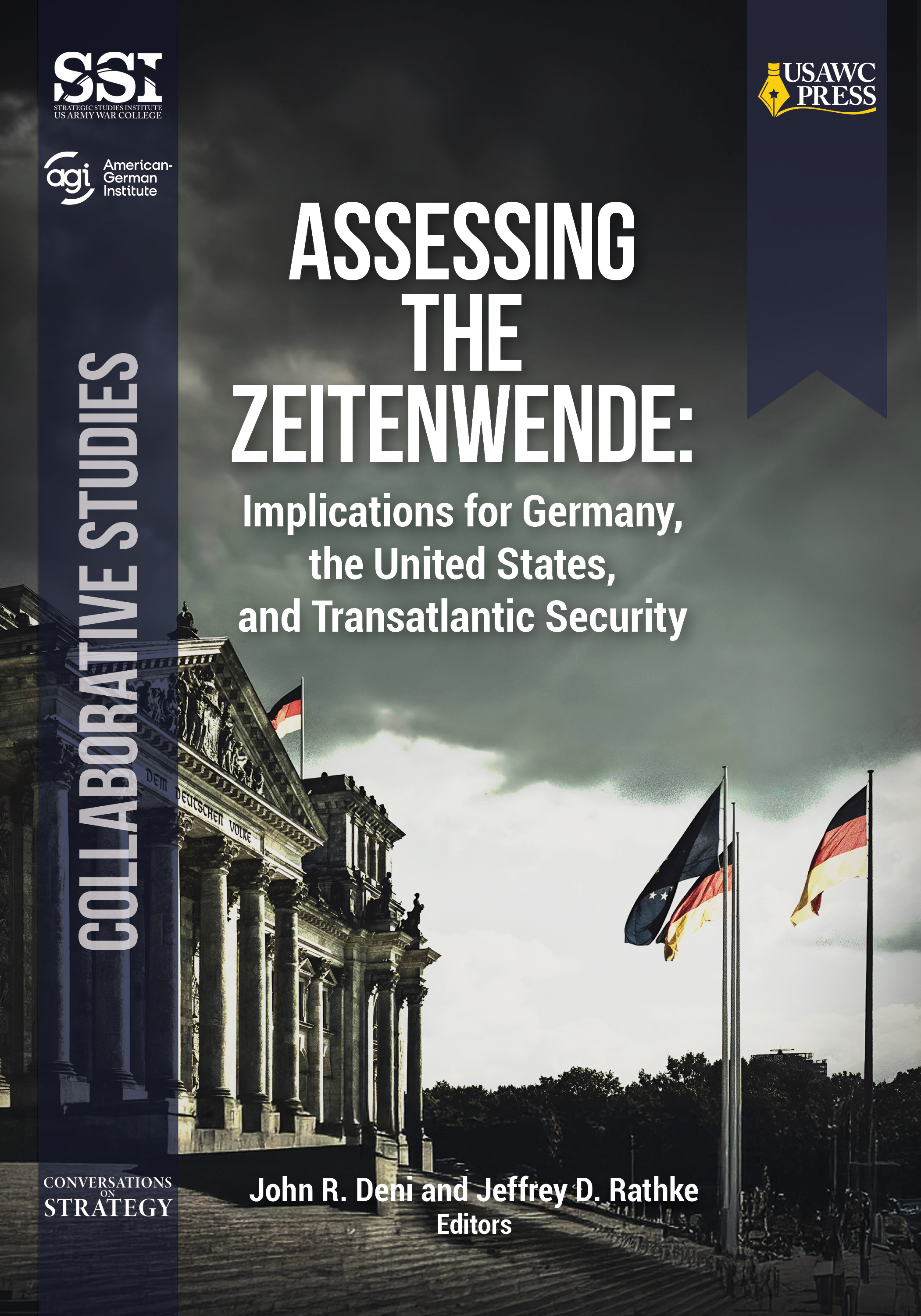
 

Assessing the Zeitenwende Cover

Download PDF   Read the Essays  


The Zeitenwende marks a major turning point in German security policy. Fundamental shifts in Germany’s energy-security strategy, policies on security cooperation, conventional military strength, approach toward Russia, and more have unfolded since February 2022. In many respects, these changes remain works in progress. Nonetheless, the decisions and actions triggered in Berlin by Russia’s devastating expansion of its war against Ukraine already appear transformative in many ways.
The changes in German security policy have had broad-based and wide-ranging implications. In particular, because German-American relations lie at the heart of the broader transatlantic relationship, when Germany promulgates a dramatic shift in strategy or policy, the implications stretch far beyond Berlin and indeed across the Atlantic. Hence, the Zeitenwende matters greatly for American policymakers as well as those across the rest of NATO and those in the EU.
Will the changes brought about by the Zeitenwende endure and be far-reaching enough to strengthen German and European deterrence and defense? The answer remains unclear. Nonetheless, assessing whether and how the Zeitenwende has met expectations and what this all means for American policymakers is particularly timely and important. The recent election in the United States and the election in Germany mean significant change in the German-American relationship may be on the horizon. Building on the successes of the Zeitenwende and identifying, correcting, or mitigating its shortcomings could provide a road map of sorts to aid Berlin and Washington in navigating the way ahead. For this reason, the US Army War College is pleased to partner with Johns Hopkins University’s American-German Institute to publish this collection of insightful, forward-looking essays.

Read the Chapters

  • Assessing the Zeitenwende Background

    Acknowledgments, Foreword, Summary, Executive Summary

  • Reichstagsgebäude (Berlin) kurz vor herbstlichem Sonnenuntergan [Reichstag building (Berlin) shortly before autumn sunset]

    On February 24, 2022, Russia unleashed a brutal escalation of what is now its 10-year war with Ukraine, which began in 2014 with the partial occupation of the Donets Basin and the illegal annexation of Crimea. The 2022 invasion expanded the war into Europe’s largest since World War II. Advancing on Ukraine along multiple axes, roughly 120,000 Russian troops poured across the border from the north, east, southeast, and south, wreaking death and destruction indiscriminately on military personnel and civilians.

  • Business success concept with chessboard on wooden and foggy background side view. man placing figure on pyramid of blocks.

    In June 2023, Germany released its first-ever National Security Strategy (NSS), making it, along with Italy, one of the last Group of Seven countries to produce such a document. For many years, calls were made for a national-level security policy document. Nevertheless, all the calls were ignored by the German government and the German chancellery, the most important actor in this process. Only in 2021 did the topic get picked up again. The coalition treaty of the new government, succeeding Angela Merkel after 16 years in power, pledged to work toward an NSS during its electoral mandate. Nevertheless, the Ampelkoalition government probably would not have committed to its pledge without Russia’s invasion of Ukraine in February 2022. Indeed, writing the NSS became part and parcel of the Zeitenwende. The strategy document was meant to codify many of the security policy and doctrine changes Germany would undertake.

  • US Capitol at Night

    The Zeitenwende has been warmly welcomed in Washington. For American policymakers, the changes in German approaches toward defense spending, energy security, and Russia more broadly have all been exceedingly positive. For some American officials, the changes might even be viewed as necessary. For the last several years, the United States has been increasingly clear about the necessity of having willing and able allies by its side for the purpose of strategic competition with Russia and China, as well as for managing transnational challenges such as terrorism. United States (US) strategies characterize allies as a comparative advantage—something American adversaries lack—or even an irreplaceable component of Washington’s approach. Germany, given its leading role in Europe, plays a key role in the constellation of American allies worldwide.

  • A German Army Leopard II tank, assigned to 104th Panzer Battalion, moves through the Joint Multinational Readiness Center during Saber Junction 2012  in Hohenfels, Germany, Oct. 25. The U.S. Army Europe's exercise Saber Junction trains U.S. personnel and 1800 multinational partners from 18 nations ensuring multinational interoperability and an agile, ready coalition force.

    The renewed and large-scale Russian attack on Ukraine that started on February 24, 2022, necessitates a fundamental rethinking of Germany’s defense policy. Therefore, this chapter analyzes to what extent Germany’s defense approach, especially in the realm of conventional capabilities and capacities, has been adjusted, and analyzes whether speaking of a real turning point (Zeitenwende) is fitting three years after its announcement, or whether Berlin is still in the process of undergoing a fundamental transformation.

  • Ammunition is organized, May 22, while soldiers from the Georgia Nations Guard and soldiers from the Georgian military train together on mid-range weapons and machine guns at Exercise Noble Partner 16.

    A Zeitenwende in German defense policy is inconceivable without a Zeitenwende for Germany’s defense industry. Such a paradigm shift must first and foremost include a sustained and predictable increase in spending levels, but it entails much more than defense budgets. Germany’s relationship with its defense industry needs to undergo a broader cultural transformation and Berlin must adopt a more strategic approach to defense-industrial policy at the national and European levels.

  • LNG tanker, GULF ENERGY - IMO 7390143, at anchor in the Karmsundet Strait beside Bukkøy Island. Haugesund, Rogaland Sounty, Norway. on May 20, 2023. While this tanker is being maintained, it has been anchored at this location for some time.

    Russian fossil fuels underpinned decades of German economic success by providing a competitive edge for industry and a seemingly reliable energy supplier in Russia. The latter became a working assumption that was supported by political and business stakeholders. Energy relations with Russia underwrote German strategic decision making, even after Russia’s annexation of Crimea in 2014. These energy relations changed in February 2022 when Russia launched a full-scale invasion of Ukraine. Such irrefutable hostility forced Berlin to place energy at the heart of the Zeitenwende.

  • Hybrid Flag of Russia and Germany

    Chancellor Olaf Scholz’s announcement of the Zeitenwende upended 50 years of German Ostpolitik, challenging the fundamental premises upon which German policy toward both Russia and the broader European security order were based. After the Soviet collapse, Germany pursued a Russia-first policy in the post-Soviet space, and its relations with Russia’s neighbors—including Ukraine—were determined by the primacy of ties with Russia post German reunification. Since the full-scale Russian invasion of Ukraine on February 24, 2022, relations with Russia have dramatically deteriorated, and Germany’s support for Ukraine in the Russia-Ukraine War has assumed priority in Berlin’s remaining ties with Moscow. But though the German government has remained committed to this new policy, German public opinion remains divided over the reversal of Ostpolitik, and recent elections in the eastern Länder indicate growing support for parties which favor discontinuing support for Ukraine and restoring ties with Russia. The Zeitenwende could be reversed, depending on the outcome of the war in Ukraine and on domestic political developments both in Germany and in the United States. This chapter will examine the historical evolution of German-Russian ties and provide a scorecard for the economic, energy, and political impacts of the Zeitenwende. It will discuss the Russian view of Germany’s new policies and examine how Germany has supported Ukraine since February 2022. This chapter concludes with the implications of the Zeitenwende for new leadership in Washington and Berlin, and for future US-German cooperation on Russia and Ukraine.

  • Flag of the European Union and Flag of the North Atlantic Treaty Organization (NATO)

    Shortly after Russia’s full-scale invasion of Ukraine and German Chancellor Olaf Scholz’s February 27, 2024, Zeitenwende speech, a long-neglected vocabulary reentered the German public discourse: national and collective defense (landesverteidigung and bündnisverteidigung). In subsequent speeches and through Germany’s first defense guidelines, published in 2023, the chancellor and his government emphasized national and collective defense must once again become the Bundeswehr’s core task—which had not been the case since the end of the Cold War.

  • 太和殿广场(12:00)
[Taihedian Square (12:00)]

    Changes in Germany’s perception of the People’s Republic of China, its global role, and its policies had been underway for some time, but the Zeitenwende meant particularly two things for Germany’s China policy. First, Germany recognized China did not stand at Germany’s and the West’s sides in condemning and aiming to stop Russia, but rather, on the contrary, China turned out to be an active Russia-neutral actor that has been using the Russian invasion of Ukraine for its own goals. And second, Germany acknowledged its critical dependency on imports and vulnerable supply chains from China at a time of conflicting paradigms and an increasing weaponization of trade.

  • Assessing the Zeitenwende Background

    Editors and Contributors